

Foil is expensive. Anyone who has run a hot foil stamping operation knows that the roll of metallized or holographic material advancing through the press represents one of the largest consumable costs in the finishing department. Yet in many production environments, the material waste rate in hot stamping processes reaches as high as 15% to 25%—a hidden cost that quietly erodes profitability.
The question is not whether your operation can afford to waste that much foil. The question is whether you can afford not to fix it.
Achieving a 3% or lower foil waste rate in mass production is not a theoretical target. It is a practical, achievable benchmark—but it requires more than just buying a machine and hoping for the best. It demands a clear understanding of where waste comes from, and a systematic approach to eliminating it at every stage of the process. Here is what it actually takes.
Where Foil Waste Comes From in Mass Production
Before you can reduce waste, you need to know where it is happening. In most hot foil stamping operations, waste falls into three main categories.
Design mismatch. If your stamping design covers only 15% of the foil ribbon width, the remaining 85% of the material advances through the press as waste. Thin linework and isolated type characters on wide panels consistently run at 60–70% waste. The geometry of the artwork directly determines how much foil is consumed per impression.
Setup and makeready. Every time you change a job, you run makeready sheets—adjusting pressure, temperature, and register. A 1,000-piece job can absorb 15–20% of its substrate in setup alone. On shorter runs, the waste from setup can make the job uneconomical before the first good sheet comes off the press.
Registration errors. Misaligned foil transfers mean rejected sheets. When holographic or registered foil applications miss their mark, the entire sheet is scrap. Some facilities experience 12–18% yield loss from misaligned holograms. That is not a production issue—it is a cost crisis.
These three sources of waste compound each other. Poor registration creates more rejected sheets. Rejected sheets mean more makeready. More makeready means more foil consumed before any saleable product is produced. Breaking this cycle requires addressing each source systematically.
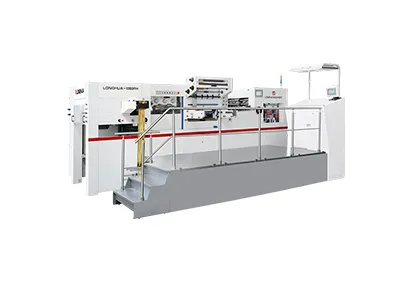
Why the Right Automatic Foil Stamping Die-cutting Machine Changes the Equation
The machine you choose determines how much of that waste you can eliminate. A well-designed automatic foil stamping die-cutting machine does not just run faster—it runs smarter, with features specifically engineered to minimize foil consumption.
Servo-Driven Foil Feeding: Eliminating Over-Advance
Traditional foil stamping pulls the foil only in the machine direction. If the job has stamps on both the left and right edges of the sheet, the press pulls a full-sheet length of foil for each impression, leaving a broad strip of unused material between the stamps.
A modern automatic foil stamping die-cutting machine with longitudinal and transverse foil feed changes this entirely. Independent servo motors drive the foil in two axes—the longitudinal axis pulls the foil across the sheet, while the transverse axis repositions the foil laterally. When the die has multiple stamping positions, the foil is pulled only the distance needed for each stamp, moving sideways between impressions without wasting an entire sheet width of foil.
The impact is substantial. A multi-stamp job that would waste 30% of foil on a single-directional press consumes only the required area for each stamp. This is not a marginal improvement—it is a fundamental redesign of how foil is delivered to the substrate.
Precision Registration: Stopping Rejects Before They Happen
Every rejected sheet is wasted foil. The most effective way to reduce foil waste is to stop producing rejects in the first place.
High-end automatic foil stamping die-cutting machines achieve registration accuracy within ±0.15 mm or better. Some systems hold foil stamping accuracy to ≤±0.1 mm. This level of precision is not achieved by accident. It requires a rigid frame that dampens vibration—ductile iron construction that keeps the foil in register across the entire run, even at full speed. It requires servo-driven motion systems that eliminate the mechanical slop of cam-driven designs. And it requires closed-loop registration systems that detect and correct misalignment in real time.
When your automatic foil stamping die-cutting machine holds register within a fraction of a millimeter, sheet after sheet, the yield loss from misaligned transfers drops to near zero. That is the single most direct path to a 3% waste rate.
Temperature Control: Consistency = Less Scrap
Temperature inconsistency is a major source of waste that is often overlooked. If the heating zones across the plate are not uniform, some areas transfer foil perfectly while others produce incomplete adhesion or scorching. The result? Rejected sheets, re-runs, and wasted foil.
Advanced automatic foil stamping die-cutting machines feature multi-zone independent temperature control with ±1°C precision. This ensures uniform heat distribution across the entire stamping area, so every impression is consistent. Operators spend less time adjusting temperature between jobs, and fewer sheets end up in the scrap bin.
Practical Steps to Get to 3% Waste or Below
Technology alone does not guarantee results. Here is what it takes to actually achieve a 3% or lower foil waste rate in your production environment.
Optimize your artwork for foil efficiency. Work with your design team to understand how artwork geometry affects foil consumption. Dense area fills are more economical per stamped piece than thin linework. Where possible, cluster stamping elements to minimize the foil ribbon width required.
Standardize makeready procedures. Every setup sheet is wasted foil. Document your optimal pressure, temperature, and register settings for each job type so that subsequent setups start from a known baseline. Reduce the guesswork, reduce the makeready sheets, reduce the waste.
Use the machine's foil-saving features. If your automatic foil stamping die-cutting machine has longitudinal and transverse foil feed, use it. If it has recipe storage for job parameters, use that too. Many machines offer step-and-repeat solutions designed to optimize the efficient use of costly foil. These features only deliver value if operators are trained to leverage them.
Monitor and measure. You cannot manage what you do not measure. Track foil consumption per thousand sheets, per job, and over time. When waste creeps up, investigate the cause—is it a registration drift? A temperature fluctuation? A die that needs replacement? Data tells you where to look.
What Support Looks Like After the Machine Arrives
A piece of equipment is only as good as the support behind it. When you invest in an automatic foil stamping die-cutting machine, the service and training you receive directly affect how quickly you reach—and sustain—your waste reduction targets.
Installation and training. Technicians should be available to install the machine and train your operators until they are fully comfortable with every function. This includes not just basic operation, but the specific features that drive foil savings—servo-driven foil feeding, registration adjustment, temperature profiling.
Documentation. A detailed user guide with installation procedures, troubleshooting steps, and maintenance schedules ensures your team can resolve issues quickly when they arise. Downtime costs more than foil.
Warranty and parts support. A comprehensive warranty that covers the entire machine—with wearing parts supplied at no charge for the first year—protects your investment during the critical ramp-up period.
Summary
Achieving a 3% or lower foil waste rate in mass production is not about buying the cheapest automatic foil stamping die-cutting machine on the market. It is about understanding where waste comes from, and choosing equipment that systematically eliminates it at every stage—from foil feeding to registration to temperature control.
What to take away:
- Servo-driven longitudinal and transverse foil feed reduces foil consumption by advancing only the material actually needed for each stamp
- Precision registration within ±0.15 mm eliminates rejects from misaligned transfers
- Multi-zone independent temperature control ensures consistent foil adhesion across every sheet
- Proper training and support ensure your operators can leverage every foil-saving feature the machine offers
Ready to Bring Your Foil Waste Under Control?
Whether you are running luxury packaging, folding cartons, or specialty print work, foil waste is a cost you can reduce—dramatically. The right automatic foil stamping die-cutting machine, combined with disciplined production practices, can get you to 3% waste or below.

