

If you have spent any time comparing Automatic Die-cutting Machine options, you have probably noticed that manufacturers talk a lot about servo motors. It sounds impressive, but what does it actually mean for your production floor? Does a servo-driven Automatic Die-cutting Machine really outperform a traditional mechanical one by enough to justify the investment?
The short answer is yes—but the reasons go far beyond marketing claims. Understanding how servo technology changes the way an Automatic Die-cutting Machine operates can help you make a smarter purchasing decision and avoid costly mistakes down the line.
The Old Way: Mechanical Cam and Asynchronous Motor Systems
To appreciate what servo motors bring to an Automatic Die-cutting Machine, it helps to understand what they replace.
Traditional die-cutting machines rely on a mechanical camshaft driven by an asynchronous motor. The camshaft coordinates all the machine’s movements—feeding, cutting, stripping, and ejecting—through a network of gears, linkages, and cams. Everything is mechanically locked together. Change one timing parameter, and you are reaching for a wrench to adjust the entire system.
This approach has been around for decades. It is well understood and relatively inexpensive to build. But it comes with real limitations. Mechanical systems wear over time. Gears develop backlash. Cams lose their precision. And when something goes wrong, troubleshooting means tracing problems through a maze of moving parts.
There is also the issue of oil. Traditional cam-driven Automatic Die-cutting Machines require regular lubrication. Oil leaks are not just messy—they can ruin entire batches of paper or board if contamination occurs.
What Servo Motors Actually Change
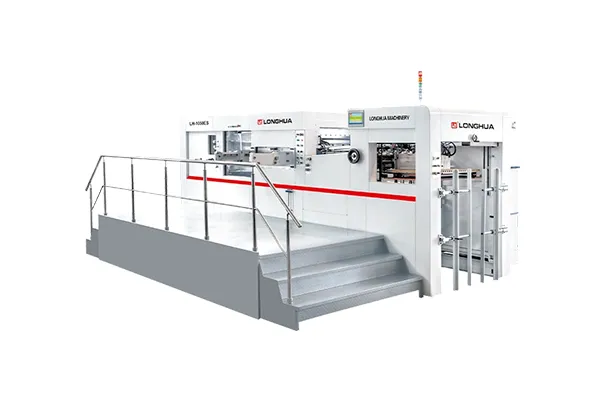
A servo-driven Automatic Die-cutting Machine replaces the mechanical camshaft with multiple independent servo motors, each controlling a specific station. Instead of one motor driving everything through gears and cams, you have separate motors for feeding, die-cutting, stripping, and waste removal.
Each motor is controlled electronically through the machine’s PLC. Timing adjustments are made on a screen, not with tools. This shift from mechanical to electronic control is the foundation of everything else.
Precision That Stays Consistent
The most immediate benefit you will notice is cutting accuracy. A servo-driven Automatic Die-cutting Machine can achieve processing precision of ±0.05mm (±5 wires)—roughly double what traditional systems deliver. Some high-end configurations reach even tighter tolerances, with repeat positioning accuracy down to 0.001mm.
Why does this matter? In packaging, even small deviations in cut position can mean the difference between a box that folds perfectly and one that does not. For pharmaceutical or cosmetic packaging, where registration accuracy is critical, that margin matters even more.
Traditional mechanical systems lose precision over time as components wear. A servo-driven Automatic Die-cutting Machine maintains its accuracy because the control loop continuously adjusts for variations. High-resolution encoders feed position data back to the controller in real time, correcting any deviation before it becomes a problem.
Speed Without Sacrificing Stability
Here is a scenario many production managers know too well: a machine rated for 200 cycles per minute that spends half its time stopped for adjustments or jam clearing.
Servo motors change this equation. They respond faster and more precisely than asynchronous motors. One reported case showed production speed increasing from 200 pieces per minute to 300 pieces per minute after switching to servo control—a 50% gain.
But raw speed is only part of the story. The real value is speed with stability. Servo-driven systems accelerate and decelerate smoothly. They do not overshoot or undershoot the way mechanical systems can at high speeds. That means fewer misfeeds, fewer jams, and less wasted material.
Energy Consumption That Actually Makes a Difference
If you are running an Automatic Die-cutting Machine for multiple shifts, energy costs add up fast.
Traditional systems keep motors running at high power continuously to compensate for mechanical inefficiencies. Servo motors, by contrast, deliver power only when needed. The energy savings are substantial. Some servo-electric die-cutting systems use up to 80% less energy than their hydraulic counterparts. Even compared to standard asynchronous motor setups, savings of 20–30% are realistic.
Over the life of the machine, that difference pays for itself.
Maintenance That Does Not Eat Into Production Time
This is where servo-driven Automatic Die-cutting Machines really separate themselves from traditional designs.
Mechanical cam systems need regular lubrication. Oil changes. Grease fittings. And inevitably, oil leaks that require cleaning and can contaminate materials.
A fully servo-driven Automatic Die-cutting Machine eliminates the mechanical camshaft entirely. No oil bath. No greasing schedule. No risk of oil stains on your paper or board. The transmission structure is simpler, which means fewer parts to wear out and less time spent on maintenance.
Installation is faster too. What once took a skilled technician six hours can be done in three and a half. That might not seem like much for a single installation, but when you are commissioning multiple machines or dealing with unplanned downtime, every hour counts.
Flexibility That Matters When Your Business Changes
Here is something that does not show up on a spec sheet but matters tremendously in real-world production: flexibility.
With a mechanical Automatic Die-cutting Machine, changing between cup sizes or product formats means mechanical adjustments. Cams need to be repositioned. Timing has to be recalibrated. It is a half-day project at best.
With servo motors, you change parameters on the touchscreen. The electronic cam profiles adjust automatically. The same Automatic Die-cutting Machine that ran 4-ounce cups this morning can switch to 16-ounce cups this afternoon without anyone reaching for a wrench.
This kind of flexibility is not a luxury—it is a competitive necessity in today’s packaging environment, where shorter runs and faster changeovers are the new normal.
What This Means for Your Production Line
The shift from mechanical to servo-driven Automatic Die-cutting Machines is not just an incremental improvement. It represents a fundamental change in how these machines operate.
Higher precision means less waste and better quality. Higher speed with stability means more usable output per shift. Lower energy consumption means reduced operating costs. Less maintenance means more uptime. And greater flexibility means you can respond to changing customer demands without major disruptions.
If you are evaluating an Automatic Die-cutting Machine for your packaging line, servo technology should be near the top of your checklist. The initial investment may be higher than a traditional mechanical machine, but the total cost of ownership over five or ten years tells a very different story.
Summary
Servo motors transform an Automatic Die-cutting Machine from a mechanically limited workhorse into a precision production tool. The key takeaways:
- Precision improves to ±0.05mm or better, eliminating the gradual accuracy loss seen in mechanical systems
- Production speed can increase by 50% while maintaining stability
- Energy consumption drops by 20–80% depending on the comparison
- Maintenance becomes simpler and cleaner—no oil, fewer wearing parts
- Changeover flexibility improves dramatically with electronic cam control
Ready to Upgrade Your Automatic Die-cutting Machine?
Whether you are replacing an aging mechanical machine or setting up a new production line, choosing the right Automatic Die-cutting Machine is one of the most important decisions you will make for your packaging operation.
Our team has helped packaging manufacturers around the world evaluate their production needs and select servo-driven Automatic Die-cutting Machines that deliver consistent output, lower operating costs, and the flexibility to grow with their business.

